Whole-Home AC Diagnostics for Uneven Cooling, Weak Airflow, and Systems That Cannot Keep Up
Is your air conditioner blowing warm air, running constantly, cycling on and off too often, or leaving certain rooms noticeably hotter than others?
Sandium Heating & Air Conditioning has served San Jose and the greater Bay Area since 2001. Our licensed professionals and factory-trained technicians diagnose cooling problems at the equipment, airflow, ductwork, and building level when the situation calls for it.
Let us evaluate the system and explain the available options before you commit to major work.
How Do You Know When Your AC Needs Repair?
An air conditioner may still run even when a component or operating condition is no longer working correctly.
Common signs that warrant an evaluation include:
- Warm or insufficiently cool air
- Weak airflow from supply registers
- An AC that runs for unusually long periods
- Frequent starts and stops
- Rooms that remain hotter than the rest of the house
- New rattling, buzzing, grinding, or other unusual sounds
- Reduced cooling performance
- Unexpected changes in energy use
- Water or condensate around the equipment
- Repeated cooling problems after previous repairs
- A thermostat that does not appear to reflect actual room conditions
These symptoms do not point to one universal repair. A system that runs continuously could have inadequate airflow, a refrigerant-related problem, insufficient capacity, or excessive heat gain in the building.
Why Is My AC Running but Not Cooling the House?
An air conditioner can operate while delivering inadequate cooling because of equipment faults, airflow restrictions, ductwork problems, sizing issues, or building conditions.
The first step is determining whether the equipment is actually producing the expected cooling and whether that conditioned air is reaching the rooms that need it.
Potential causes include:
- Restricted filters or airflow pathways
- Dirty evaporator or condenser coils
- Blower or fan problems
- Refrigerant-related faults
- Electrical or control problems
- Duct leakage or restrictions
- Inadequate return airflow
- Equipment sizing issues
- Poor insulation or air leakage
- Excessive heat gain in particular rooms
This distinction matters because replacing a functional air conditioner will not necessarily correct a ductwork or building-performance problem.
What Does an AC Repair Include?
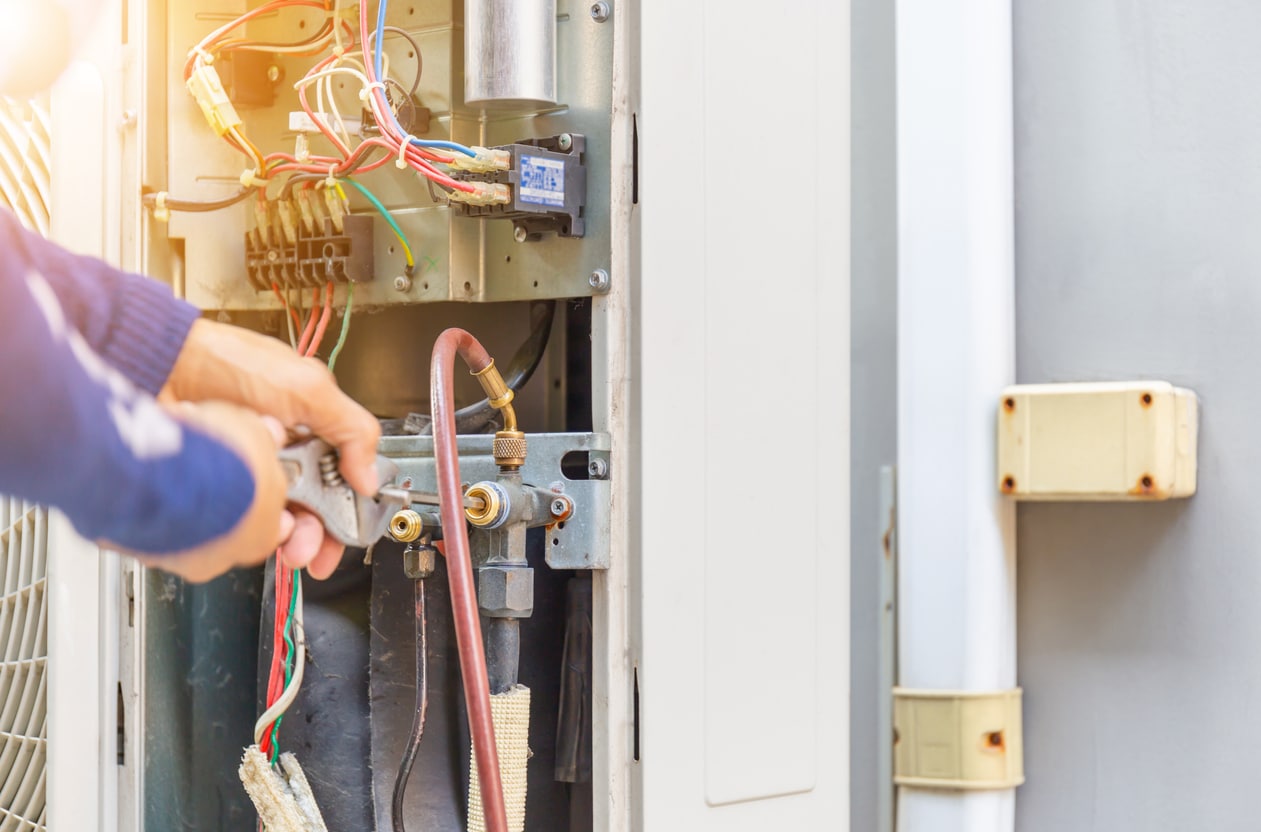
AC repair involves diagnosing the operating problem, identifying the underlying fault, correcting the issue, and testing the system afterward.
The exact work depends on the equipment and symptoms. A technician may evaluate:
- Thermostat operation
- Electrical components and controls
- Evaporator and condenser coils
- Blower operation
- Filters and airflow
- Refrigerant-related conditions
- Condensate drainage
- Ductwork and air distribution
- Overall system operation
Not every component needs attention during every visit. The diagnostic process should follow the reported symptoms and observed system behavior.
For example, a frozen evaporator coil is not necessarily the root problem. Restricted airflow or a refrigerant-related fault can produce similar symptoms. Likewise, low refrigerant should prompt an evaluation of the system rather than being treated as routine maintenance.
The objective is to identify why the system is malfunctioning, not simply restore operation temporarily.
What Causes Common AC Problems?
Different failures produce overlapping symptoms, which is why guessing at the cause can lead to unnecessary repairs.
Warm Air
Warm supply air can result from equipment malfunction, refrigerant-related conditions, compressor or electrical problems, airflow issues, or control problems.
Weak Airflow
Reduced airflow may involve a restricted filter, blower problem, duct restriction, inadequate return air, or another distribution issue.
Constant Runtime
Long runtimes can occur when the equipment cannot meet the cooling load, airflow is restricted, the system has a capacity problem, or the building is gaining more heat than expected.
Short Cycling
Frequent starts and stops can be associated with equipment, controls, airflow, sizing, or other operating conditions. Repeated cycling should be evaluated rather than treated as normal behavior.
Uneven Temperatures
Hot rooms can result from ductwork, insulation, solar exposure, zoning, room layout, equipment sizing, or inadequate air distribution.
The same symptom can therefore have several possible causes.
Why Does One Room Stay Hot While the Rest of the House Is Comfortable?
A hot room does not necessarily mean the air conditioner is too small or failing.
The problem may be localized to the way conditioned air reaches that room. Supply duct restrictions, insufficient return air, duct leakage, insulation, window exposure, room orientation, and changes made during remodeling can all affect temperature.
The thermostat also only measures the conditions around its own location. If the thermostat reaches its setting while a distant bedroom remains hot, the system may shut down even though that room has not reached the desired temperature.
Sandium can evaluate ductwork and airflow when the evidence points beyond the AC equipment.
Explore Air Duct Repair and Installation
Does Low Refrigerant Mean My AC Needs Refrigerant?
Not necessarily. Low refrigerant is a condition that should be diagnosed, not treated as routine AC maintenance.
If the system has lost refrigerant, the underlying cause should be investigated. Refrigerant-related problems can affect cooling capacity and system operation, but the appropriate repair depends on what the evaluation finds.
This is one example of why an AC diagnosis should identify the cause before corrective work is selected.
Can a Dirty Filter Cause AC Problems?
Yes. A heavily restricted filter can reduce airflow through the system and contribute to poor cooling performance. Depending on the equipment and operating conditions, restricted airflow can also contribute to coil-related problems.
Filter condition is only one possible cause, however. Replacing a filter will not correct an electrical failure, refrigerant-related fault, damaged ductwork, or equipment problem.
Routine filter care is useful, but abnormal cooling performance still calls for proper diagnosis.
When Is AC Repair Better Than Replacement?
Repair is generally worth considering when the equipment remains in reasonable condition and the current problem is isolated and practical to correct.
Replacement deserves closer evaluation when:
- Repairs have become frequent
- The equipment has become unreliable
- Cooling performance continues to decline
- Major components have failed
- Repair costs are becoming difficult to justify
- The existing system no longer fits the home
- Efficiency is no longer aligned with the homeowner’s goals
- Ductwork or other system conditions make a larger HVAC project appropriate
There is no single equipment age at which replacement becomes mandatory. The decision should account for the system’s condition, repair history, performance, cost, and the property’s longer-term requirements.
If another contractor has recommended replacement, Sandium offers free second opinions before homeowners commit to major work.
What If the AC Works but Your Energy Bills Keep Rising?
Higher energy use does not automatically mean the air conditioner needs replacement.
An AC that runs longer than it should may be responding to restricted airflow, duct leakage, inadequate insulation, air leakage, excessive heat gain, or equipment deterioration.
If equipment operation appears normal but energy performance remains a concern, a broader building evaluation may be appropriate. Sandium also provides home energy audits that examine HVAC performance alongside insulation, ductwork, ventilation, and other building conditions.
When Should an AC Problem Be Treated as Urgent?
Some cooling problems can wait for a scheduled appointment. Others warrant prompt attention.
Contact an HVAC professional when the system stops cooling, develops a significant electrical or operating problem, repeatedly cycles abnormally, or shows signs of a condensate or other equipment issue.
Sandium advertises 24/7 availability for emergency HVAC service, which can be relevant when a cooling failure cannot reasonably wait for normal scheduling.
What Happens During an AC Repair Appointment?
The service process should provide enough information to distinguish an actual equipment failure from a larger comfort problem.
1. Describe the Change in Performance
The technician reviews what changed, when the problem started, which rooms are affected, and whether the system has had previous repairs.
2. Evaluate System Operation
Relevant equipment, controls, electrical components, airflow, and other operating conditions are examined according to the complaint.
3. Trace the Symptom to Its Source
The evaluation considers whether the problem is originating within the AC equipment or involves ductwork, airflow, controls, or building conditions.
4. Explain the Findings
The homeowner receives an explanation of the observed problem and what work is actually necessary.
5. Present Repair or Replacement Options
If repair is practical, the necessary work can be discussed. If the equipment has reached a point where replacement deserves consideration, those factors can be explained as well.
6. Complete and Test the Work
After an approved repair, the system is operated and tested to verify that the relevant problem has been addressed.
What If the AC Cannot Be Repaired Economically?
Sometimes the diagnostic process shows that continued repair is no longer the most practical option.
In that situation, the replacement decision should consider more than the new air conditioner’s capacity. Equipment sizing, ductwork, airflow, controls, building characteristics, and future heating requirements can all affect the appropriate replacement strategy.
Depending on the property, homeowners may also want to compare a conventional AC system with a heat pump that can provide both heating and cooling.
For additions, individual rooms, or ADUs where conventional ductwork is difficult to extend, a ductless mini-split may be another option.
Explore Ductless Mini-Split Services
AC Maintenance After a Repair
Repair addresses a specific operating problem. Maintenance serves a different purpose by providing an opportunity to inspect system condition and identify developing issues.
Depending on the equipment, maintenance may involve examining filters, coils, electrical components, airflow, controls, condensate components, and overall system operation.
If the AC is already showing abnormal behavior, however, diagnostic repair service is more appropriate than treating the issue as a routine tune-up.
Why Use Sandium for AC Repair?
Sandium has served San Jose and the greater Bay Area since 2001. The company lists California contractor license #1140043 and identifies C-20, C-2, and B General Building Contractor licenses.
Sandium states that its teams are factory trained and receive mandatory safety training twice each month. The company also works across heating, cooling, ductwork, indoor air quality, and home performance services.
That broader capability can be useful when a cooling complaint involves more than the air conditioner itself.
Sandium advertises free second opinions, no-obligation estimates, financing options for qualifying customers, and a 100% Satisfaction Guarantee.
Learn More About Sandium’s Experience and Qualifications
AC Repair for San Jose and the Greater Bay Area
Sandium is based in San Jose and serves homeowners and other properties throughout the surrounding Bay Area, including Sunnyvale, Campbell, Cupertino, Santa Clara, Mountain View, Palo Alto, Los Altos, Los Altos Hills, Saratoga, Los Gatos, Menlo Park, and Atherton, among other communities.
The area’s housing stock includes older homes, newer construction, remodeled properties, hillside homes, additions, and ADUs. Those differences can affect how an AC problem should be diagnosed and what solutions are practical.
Frequently Asked Questions About AC Repair
How do I know if my AC needs professional repair?
Warm air, weak airflow, unusual noises, frequent cycling, persistent hot rooms, or a noticeable decline in cooling performance are good reasons to schedule an evaluation. The symptom itself does not identify the cause.
Should I repair my AC or replace it?
Consider equipment condition, age, repair history, efficiency, repair cost, airflow, ductwork, and long-term plans. A free second opinion can be useful when another contractor has recommended replacement.
Can poor ductwork make my AC seem like it is failing?
Yes. Restricted, leaking, damaged, or poorly configured ductwork can contribute to weak airflow and uneven temperatures even when the equipment itself is operating.
Does Sandium offer emergency AC service?
Sandium advertises 24/7 business availability and emergency HVAC service. For an urgent cooling problem, contact the company to confirm current response and appointment availability.
Does Sandium offer free second opinions?
Yes. Sandium currently promotes free second opinions for major repair and replacement decisions.
What if my AC problem is actually related to another part of the home?
That is where a broader system evaluation can help. Airflow, ductwork, insulation, building conditions, thermostat location, and equipment sizing can all affect cooling performance. Sandium also provides ductwork, energy auditing, indoor air quality, heat pump, and ADU HVAC services.
Get a Clearer Answer About Your AC
If your air conditioner is running but your home is not cooling properly, start with the problem rather than assuming the solution.
Sandium Heating & Air Conditioning can evaluate the equipment and relevant system conditions, explain what the findings mean, and help you determine whether AC repair, maintenance, ductwork work, further diagnosis, or replacement makes sense.
Request AC Service or a Free Second Opinion